Heritage Paint Colours
Heritage colours draw on the pigments and palettes of Britain's historic interiors: chalky lime whites, Georgian stones, earth reds and ochres, deep Victorian shades and Arts & Crafts greens. Ours are heritage-inspired rather than reproductions, so they suit period homes and new builds alike. Every shade below is available as a 60ml sample.
Heritage colours are the colours of Britain's historic interiors: chalky lime whites, the stones and drabs of Georgian rooms, earth pigments like ochre, umber and red oxide, the deep reds and greens of Victorian houses and the leafy greens of the Arts & Crafts movement. We've designated well over half our palette as heritage-inspired because each colour resembles one of those historic pigment families or period palettes. To be clear, these are contemporary colours with historical affinities, not certified reproductions of an original scheme, and they suit period homes and new builds alike.
At a glance
- Start here
- Inspired by history, made for now. These are contemporary colours with historical affinities, not certified reproductions. Use them as a design palette in any home.
- North light
- Earth reds and warm stones. Cool north light suits the warm earth pigments of historic palettes: ochres, red oxides, umbers and warm stones.
- South light
- Greens, drabs and lime whites. Bright, warm light flatters Arts & Crafts greens, greyed Georgian drabs and soft lime whites.
- East light
- Bright mornings, cooler afternoons. Warm stones and soft off-whites stay welcoming as the light cools later in the day.
- West light
- Golden evenings on deep colour. Warm evening light brings out Victorian reds, browns and deep greens. Check them in the flatter morning light too.
- Period
- Match the mood, not the date. Georgian rooms leaned on stones and drabs, Victorian rooms on deep reds and greens, Edwardian rooms on lighter creams. You do not need to match your house’s age.
- Listed?
- Ask before you paint. In a listed building, speak to your local conservation officer before redecorating historic surfaces.
- Sample tip
- Check every change of light. Move your sample between walls. Check it in morning and afternoon daylight, then under the lights you use at night.
Tap any tile to read more.
Lime whites and chalky off-whites
Soft, chalky whites with an old-house glow.
Historic limewash and soft distemper were rarely brilliant white: impurities and tints gave them a soft, warm or greyed cast. These off-whites recall that look. Paired with our Dead Matt finish, which has a soft, chalky look on a durable, scrubbable film, they're the closest modern walls get to that gentle old-house glow.
A heritage colour doesn't make a modern paint a limewash or distemper. On lime plaster or other historic surfaces, choose the coating for the substrate first and take conservation advice.
Georgian stones and drabs
Economical stones and drabs that flatter proportion.
Georgian architecture was conceived in stone, and most Georgian rooms were painted in the economical "common colours": stones, buffs, drabs and greys. Far from dull, they flatter proportion, panelling and natural light, and they make a calm backdrop in any home.
Ochres, earth reds and clay
Ochres, siennas and red oxides from historic pigments.
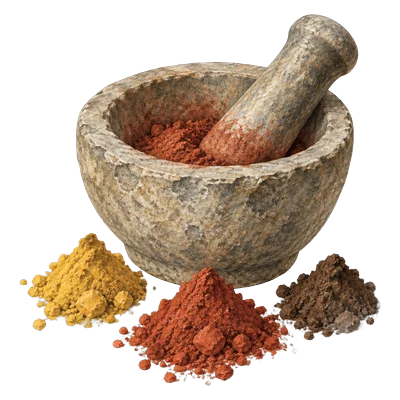
, , and red oxide were the affordable backbone of historic colour, and heating them shifts their colour from golden buff to russet and brown. These are the colours of cottage walls, farmhouse kitchens and Arts & Crafts schemes.
Victorian depth
Deep reds, greens and browns for rich rooms.
Deep reds, bronze and dark greens, purple-browns and rich browns anchor the Victorian palette. They are wonderful in dining rooms, halls and studies, and on doors and panelling.
Arts & Crafts greens
Olive and leafy greens for natural materials.
Olive and leafy greens sat alongside earthy reds, ochres, natural materials and patterned textiles in Arts & Crafts interiors. These muted greens are just as happy beside oak, linen and William Morris prints today.
Lighter Edwardian and interwar colour
Lighter creams, greens, blues and rose.
Edwardian houses generally moved towards lighter creams, off-whites, quiet greens, blues and rose; interwar palettes added delicate blues, warm buffs and blue-greens. Fresh, gentle colours for bedrooms and sitting rooms.
Sample it the way we would
Step 1
Paint your peel-and-sticks
Each £5.99 sample comes with three paintable peel-and-sticks. Give them two coats and let them dry fully.
Step 2
Stick them around the room
Put them on two or three walls, including the wall opposite the window, at eye level and lower down.
Step 3
Live with them for a day or two
Look in the morning, the afternoon and under your evening lamps. Move them around until you are sure.
Your questions, answered
What are heritage paint colours?
Colours associated with historic decorating traditions, or modern colours inspired by them. Some ranges reproduce analysed historic samples; ours are heritage-inspired, chosen for their resemblance to historic pigments and period palettes.
Do I need heritage colours in a listed building?
There's no blanket rule that you must use a heritage-branded paint. In England, listed building consent is needed for works that affect a building's special interest, and redecoration can need advice or consent depending on the surfaces involved. Speak to your local planning authority's conservation officer first, especially where historic decoration survives.
Is heritage paint suitable for lime plaster?
A heritage colour does not tell you whether a paint suits lime plaster. Choose the coating for the surface first; traditional limewash or distemper may be the right answer, and conservation advice is wise.
Can heritage colours work in a modern home?
Absolutely. Use them as a design palette rather than a reconstruction: historic stones, greens and earth colours sit beautifully in new builds, and you don't need to match your house's construction date.
Are heritage colours always dark or muted?
No. Historic interiors included pale whites, blues and greens as well as strong yellows, blue-greens and rich reds. Regency and interwar schemes in particular could be vibrant.