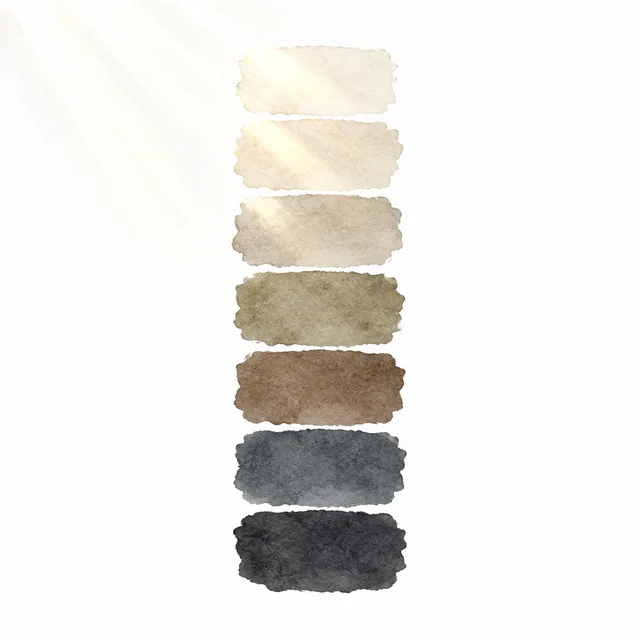
Light reflectance value, or LRV, is a number from 0 to 100 describing how much visible light a surface reflects, weighted to the way the human eye responds to light. Zero would be a perfect black that absorbs everything and 100 a perfect white that reflects everything; real paints sit in between. Paint makes no light of its own, so LRV is the clearest single guide to how light or heavy a colour will feel once it covers a room. Higher-LRV colours bounce more of the daylight and lamp light that reaches them back into the space, so rooms feel brighter and more open. Lower-LRV colours absorb more of it, so walls read deeper and the room feels more enveloping. That matters most where light is scarce, such as north-facing rooms, hallways and small rooms with one window, where every bit of reflected light counts.
In the UK, laboratory LRVs are measured to BS 8493, the British Standard method of test. A spectrophotometer reads a flat, dried sample of the coating and reports its CIE Y value, the luminance factor, for standard daylight (illuminant D65) and the CIE 10° observer. The LRVs on our colour pages are calculated rather than laboratory-tested. Each one is worked out from the colour’s measured CIELAB lightness (L*, D65, 2° observer), using the standard CIE relationship between L* and Y. That gives a consistent way to compare our shades with each other, but they are not drawn-film LRVs measured to BS 8493, and a laboratory reading of a painted sample can differ slightly. Across our current palette, calculated LRVs run from 3 to 95.
Compare the LRVs of the colours on your shortlist: the higher number will feel lighter on the wall, even when two shades look similar on a screen. LRV also helps you plan contrast. British accessibility guidance in BS 8300-2 generally looks for a difference of at least 30 LRV points between surfaces that need to stand apart, such as a door and the wall around it, with 20 points acceptable in some situations, particularly for large areas or brightly lit rooms. At home the same idea helps you decide how strongly woodwork, doors or a ceiling should stand out from the walls, or how gently they should blend. LRV only describes lightness, though. It says nothing about undertone, so two greys with the same LRV can lean warm or cool, and it does not capture sheen: the same colour in a glossier finish reflects more light at its surface and can look a little lighter and livelier than in matt. Use LRV to narrow a shortlist, then test samples on your own walls in daylight and under your evening lamps.
Our LRVs are calculated from measured Lab data, not laboratory drawn-film tests to BS 8493. Use them to compare our shades, then confirm your choice with a real sample in your own light.